Joker’s catatonia
Batman the Dark Knight Returns 10th Anniversary Edition HardcoverJoker’s catatonia is the prolonged institutionalized condition in which The Joker remains unresponsive and removed from public life before his sudden reemergence. Its decisive significance lies in the contrast between visible inactivity and latent danger: Gotham City treats The Joker as contained, but the narrative turns his silence into a suspended threat whose release helps reopen the old conflict between The Joker and Bruce Wayne / Batman.
Institutional Silence and Apparent Containment
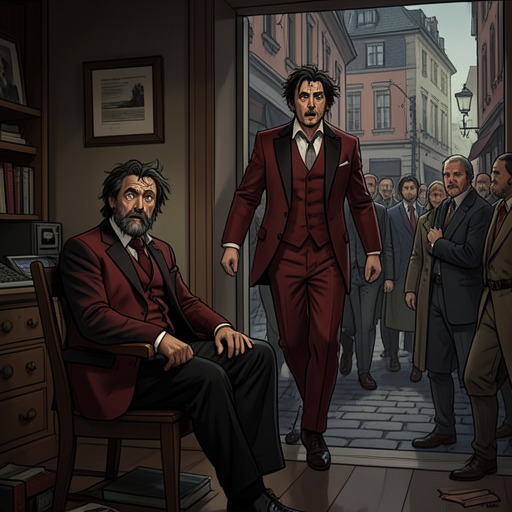
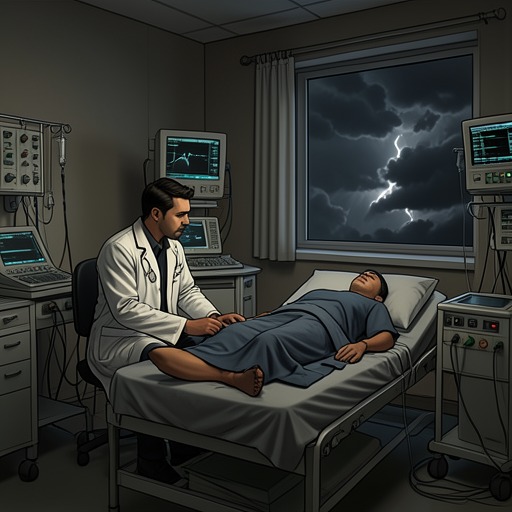
The Joker’s condition belongs to the period in which Bruce Wayne / Batman has retired and Gotham City’s social decay has made former crimes seem to belong to an exhausted past. The Joker is kept in an institution while Bartholomew Wolper interprets his condition for the public, allowing medical and institutional language to replace the earlier image of an active criminal adversary. The apparent solution is not rehabilitation or reconciliation but removal: The Joker has ceased to act, and therefore seems to have ceased to matter.
That stillness also creates a public contrast with Bruce Wayne / Batman. Bruce Wayne / Batman has withdrawn from his identity as a response to age, bodily decline, and the city’s changed political order, while The Joker’s withdrawal is imposed through institutional confinement and catatonic silence. One figure appears to have chosen retirement; the other appears to have been rendered harmless. The parallel is unstable, however, because neither condition resolves the forces that produced the conflict. Gotham City’s problems persist, and The Joker’s capacity for violence remains concealed rather than transformed.
The Return of the Suppressed Threat
When Bruce Wayne / Batman returns, The Joker’s catatonia functions as part of the story’s larger pattern of dormant identities becoming active again. The resurgence of Batman’s public presence coincides with the reactivation of the adversary most closely bound to his history. The Joker does not simply recover from an illness in a private medical narrative; his institutionalized state gives way to a renewed criminal presence at the moment Gotham City is already destabilized by violence, fear, and failures of authority.
Bartholomew Wolper’s role intensifies the ambiguity surrounding the condition. By treating The Joker as a product of social and psychological forces, Wolper helps frame him as an object of explanation rather than an immediate agent of danger. The narrative subsequently exposes the limits of that framing. Whatever interpretive account the institution supplies, it does not prevent The Joker from returning to action, and the gap between diagnosis and consequence becomes part of the story’s criticism of reassuring public explanations.
From Catatonia to Mass Violence
The change from silence to action is not gradual rehabilitation but a violent reversal. The Joker escapes institutional control and resumes the pattern associated with his earlier crimes, transforming a condition that seemed to signify passivity into the starting point of renewed destruction. His escape is followed by a massacre, so that the institutional failure is measured not by an abstract breach of security but by the immediate suffering inflicted on civilians.
The Joker’s reappearance also redirects the plot of Bruce Wayne / Batman’s return. Batman’s earlier campaign has focused on Gotham City’s street violence and the Mutant Gang Uprising, but The Joker restores a more intimate and personal form of antagonism. The threat is no longer only collective disorder or the Mutant Gang’s rule of Gotham; it is the return of a singular criminal whose violence is theatrical, targeted, and inseparable from Batman’s own history.
Relationship to Bruce Wayne / Batman
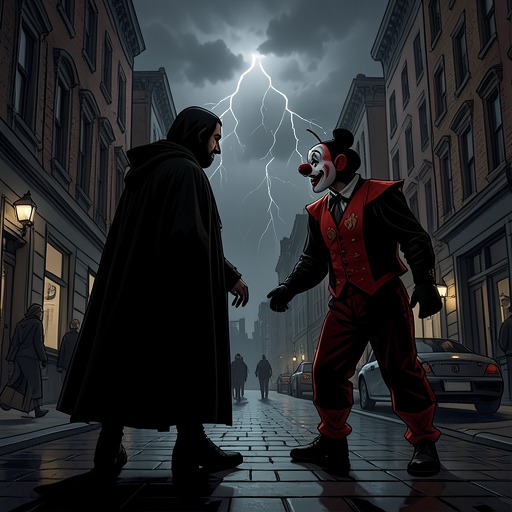
Joker’s catatonia temporarily suspends the defining relationship between The Joker and Bruce Wayne / Batman, but it does not dissolve it. The absence of an active The Joker leaves Batman without one of the enemies through whom his identity has traditionally been tested. Once The Joker returns, that dormant relationship becomes active again, and the conflict moves toward The Joker’s final confrontation with Batman.
The contrast between the two figures is particularly sharp because both are associated with a refusal to accept ordinary retirement. Bruce Wayne / Batman reclaims a forbidden public role to confront Gotham City’s collapse; The Joker emerges from institutional stillness to resume destruction. Their parallel returns suggest that the opposition is not merely between a healthy defender and a sick criminal. It is between two identities sustained by conflict, each becoming legible again when the city’s order proves unable to contain what it has repressed.
Narrative Function and Ending
The Joker’s catatonia is therefore a state of suspension rather than an ending. It delays The Joker’s return, permits Gotham City and its institutions to treat him as a closed case, and makes his eventual escape more disruptive. The condition also heightens the story’s recurring doubt that violence can be solved by disappearance alone: Batman’s retirement does not cure Gotham City, and The Joker’s institutionalization does not cure The Joker.
The state ends in action, public terror, and renewed personal conflict. After The Joker’s escape and massacre, the old antagonism culminates in Batman’s final confrontation with The Joker, where their relationship reaches its terminal form. Catatonia thus operates as the quiet interval before the final eruption, a false peace whose collapse demonstrates that containment without transformation leaves the underlying cycle intact.